Category Archives: Food

Making Sausage: A Family Tradition

My husband and I have hung out for a long time:  we dated for 8 years and have been married for 20 years.  Early on in our relationship, he introduced me to his family’s mostly-annual tradition of making German sausage.  I do not remember the year I was first invited to join in the tradition, but I do remember being amazed, and maybe even a little shocked by the process.  Although I too was a farm kid, I had never thought about how the sausage that I ate was actually made.

The event took place at his parent’s house and I managed to avoid participating up until it was time to weigh and package the newly ground sausage.  Someone handed me a big stainless steel bowl of fresh sausage and instructed me to start weighing and packaging the sausage in one-pound packages.  Being a teenager, and new to the family besides, I felt like I had no other choice than to roll up my sleeves, wash my hands in bleach water, and get started.

The sausage-making tradition has continued through the years, taking place in different locations and with different combinations of family members in attendance.  The equipment has been upgraded, the recipe is always being altered/improved, and the process continues to be refined.  Over the past several years, we have hosted the event at our home on the day after Thanksgiving.  We choose this weekend because people are free for the holiday weekend and the temperatures are typically cold enough that we do not have to worry about keeping the meat cold throughout the process.

Although I am unsure how far back this family tradition dates, I know it goes back at least to my husband’s childhood when they used to make sausage at his grandma and grandpa’s farm.  The recipe is of German origin, but has been changed over the years based on available ingredients and in response to discussions about possible improvements.  One thing has remained the same however, this family knows how to make good sausage.

Cleaning and Setting Up

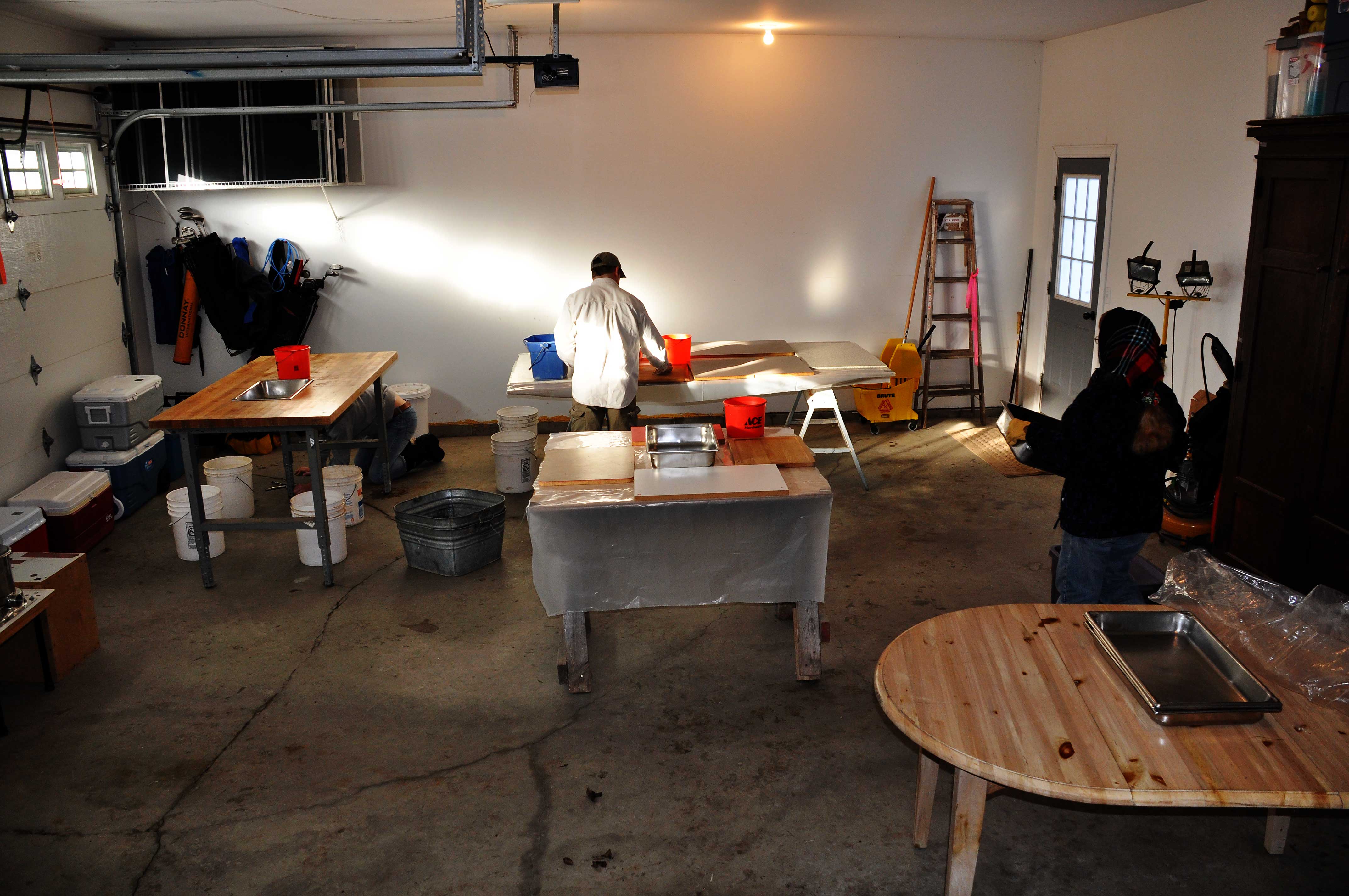
We hosted this family event at our house again this year.  The preparation process is a long one and requires completely cleaning out our garage, mopping the floors with bleach water, hauling equipment in from various storage locations, and setting everything up.  We place clean plastic on all the tables and wipe them down with bleach water.  Cutting boards, knives and containers are also washed.  We do all this prep work on Thanksgiving evening, so it helps us work off that big turkey dinner.
Mixing the Spices

In addition to the cleaning and setting up, another important preparation that we do the night before is to mix the spices.  My mother-in-law purchases all the spices, mostly in bulk, and works with our three kids to measure them out into pint jars.  Each jar is enough spices to season 30 pounds of sausage.  The kids stand in a line and she gives them the measurement and they pass each ingredient down the line, placing the correct amount in the jars in front of them.
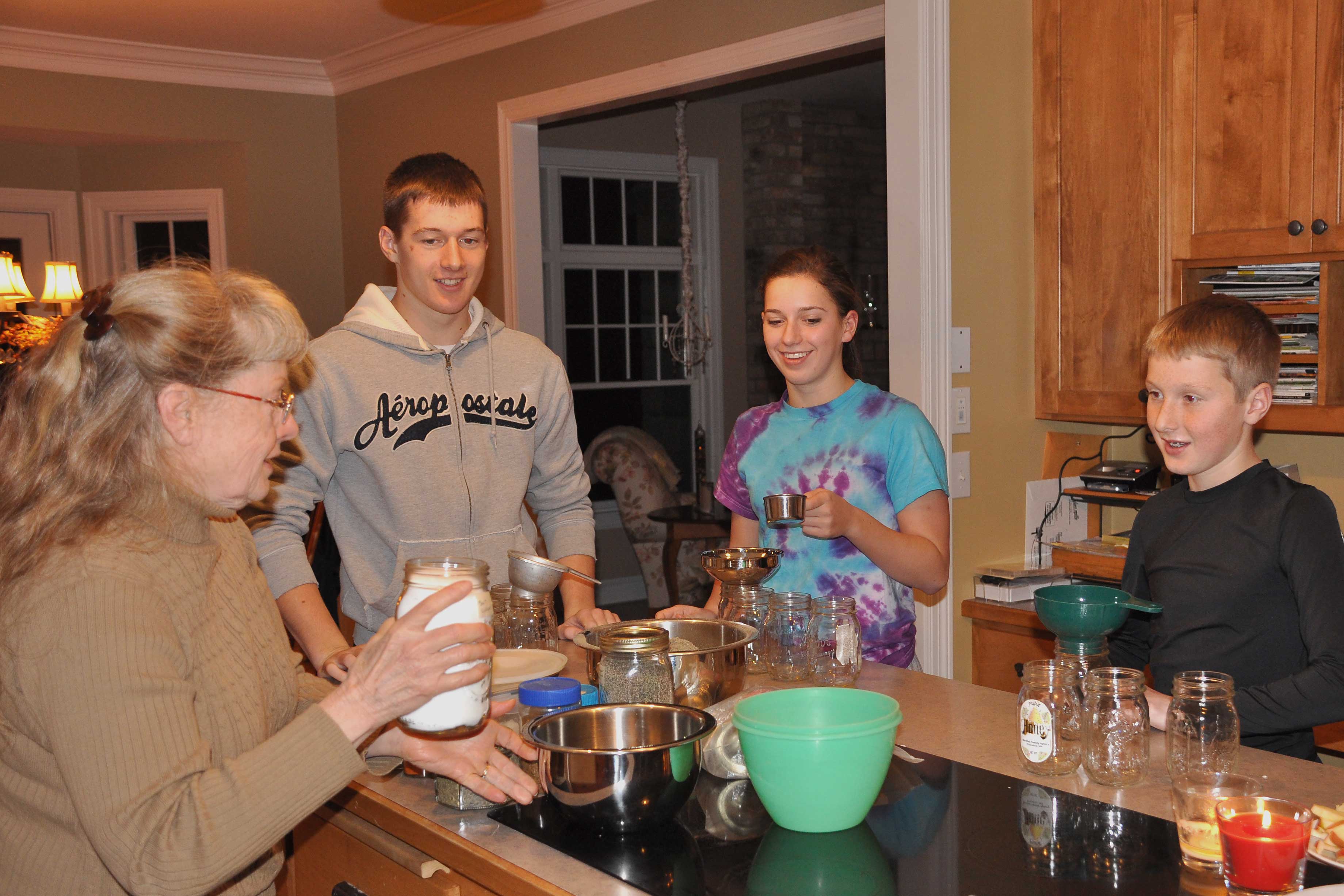
My mother-in-law is in charge of the recipe so I don’t know the exact ingredients, but the spices at least include various amounts of salt, black pepper, sage, coriander, summer savory, all-spice, fennel seed, cayenne pepper, sugar and clove oil.

Sectioning and Cutting

In the morning of sausage-making day, someone goes to the locker to pick up the hogs.  This year we ordered 2 whole hogs, each with a hanging weight of around 220 pounds.  Our oldest son and an uncle both got a deer during hunting season this year, so we purchased an extra 30 pounds of pork trimmings to mix with the venison to make sausage.

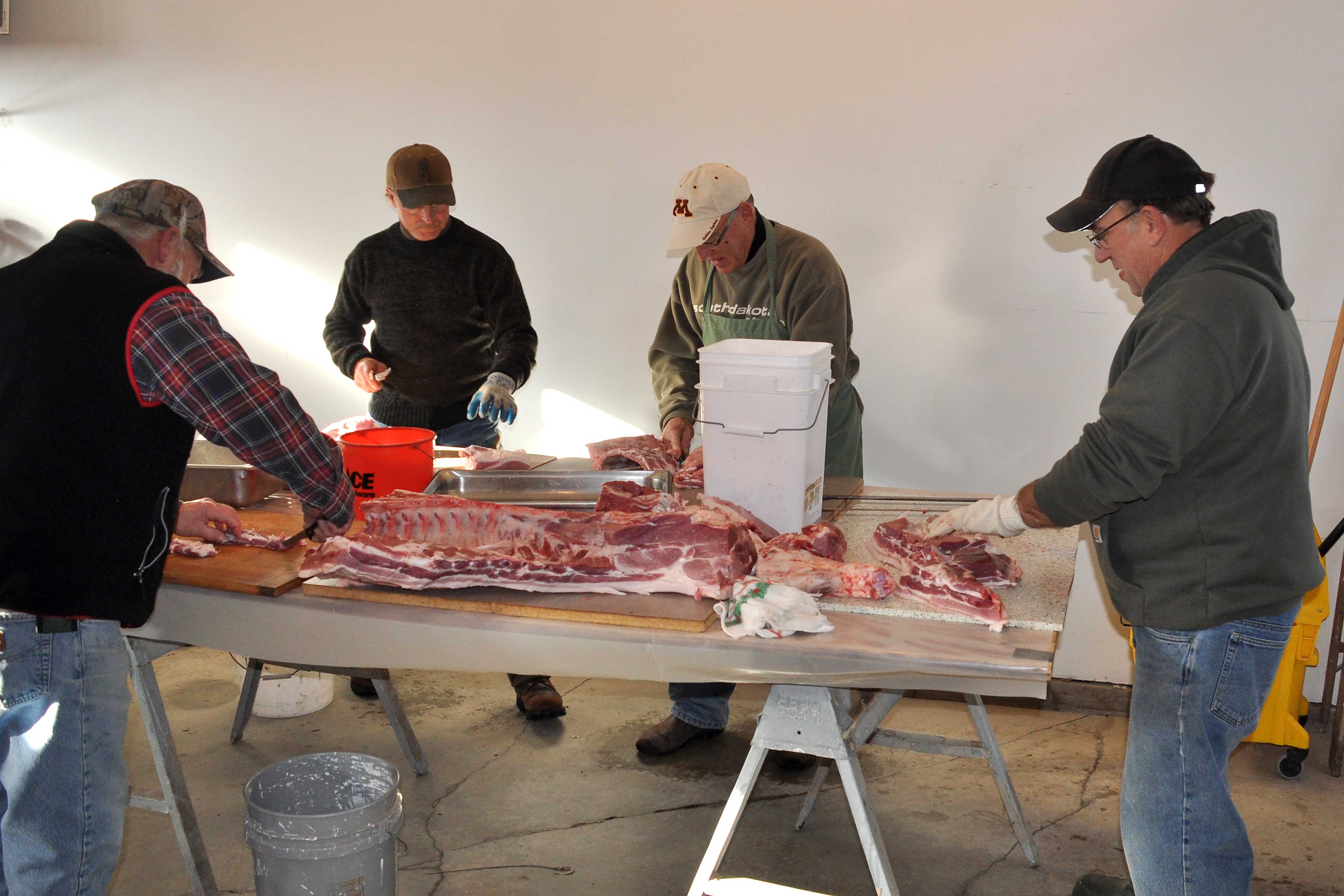
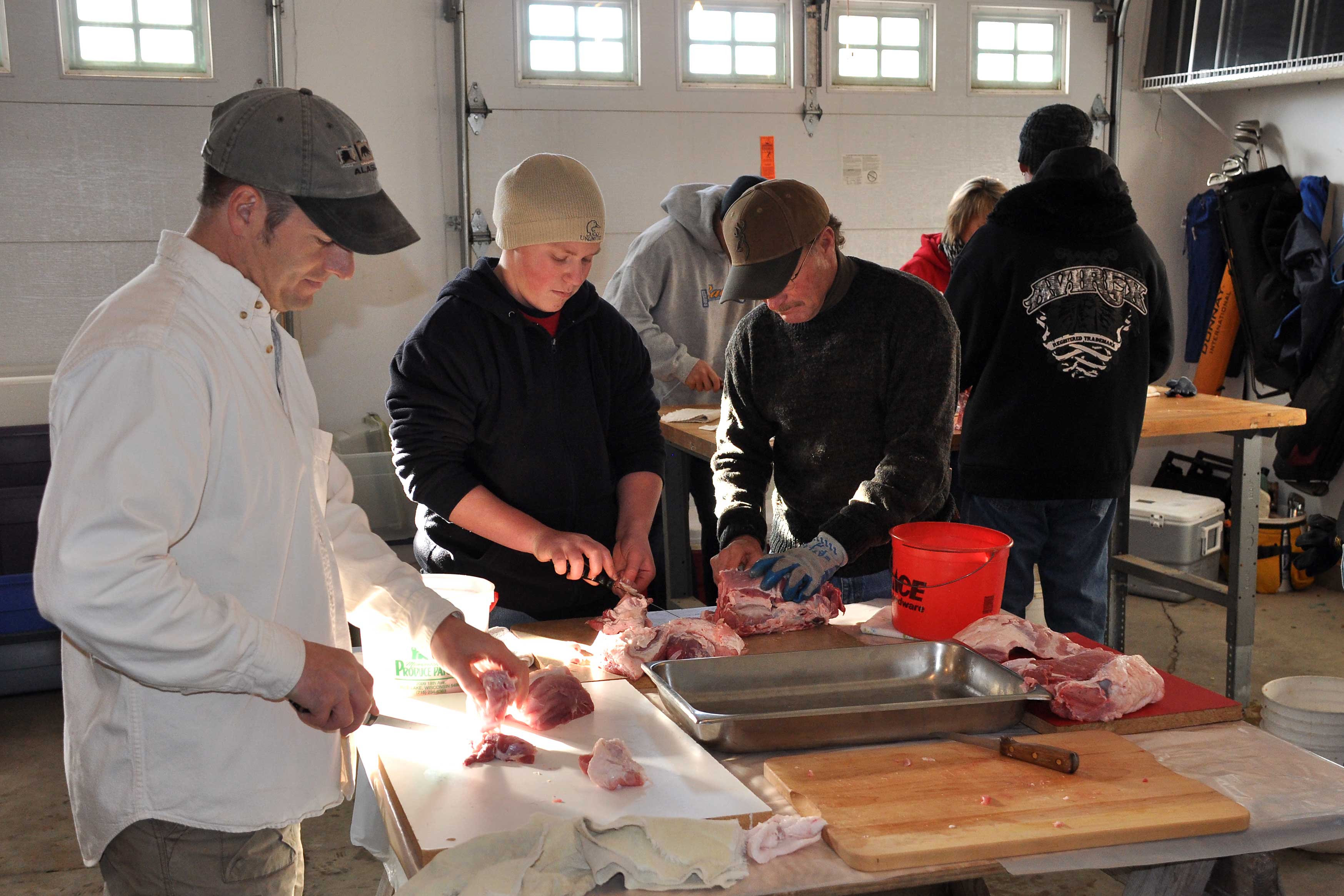
Once people start to arrive, the cutting begins.  The hogs are cut into sections and the people cutting are given sections from both the front and rear quarter for cutting.  The idea is to get a good blend of the different cuts of the hog, mixing together both the premium and more standard meat.  The meat is cut off the bone into cubes or chunks for grinding.  We had three tables set up for cutting.
Whole Hog Sausage

Sausage is commonly made from the scraps and least desirable cuts of the hog.  In contrast, the sausage we make is a “whole hog” sausage, which means that it includes all parts of the hog, including the premium cuts: ham, tenderloin, shoulder, etc.
Grinding

As the meat is cut off the bone, the chunks of meat from each table are moved over to the grinding area.  A few years ago, the family purchased a 1.5 horsepower commercial grinder to improve the process.  It has been a great addition to the sausage-making equipment.

The ground pork is put into a tub and weighed.  The batches of sausage we make consist of 24 pounds of ground pork mixed with 6 pounds of ground beef.  Once there are 24 pounds of ground pork ready for processing, the mixing begins.
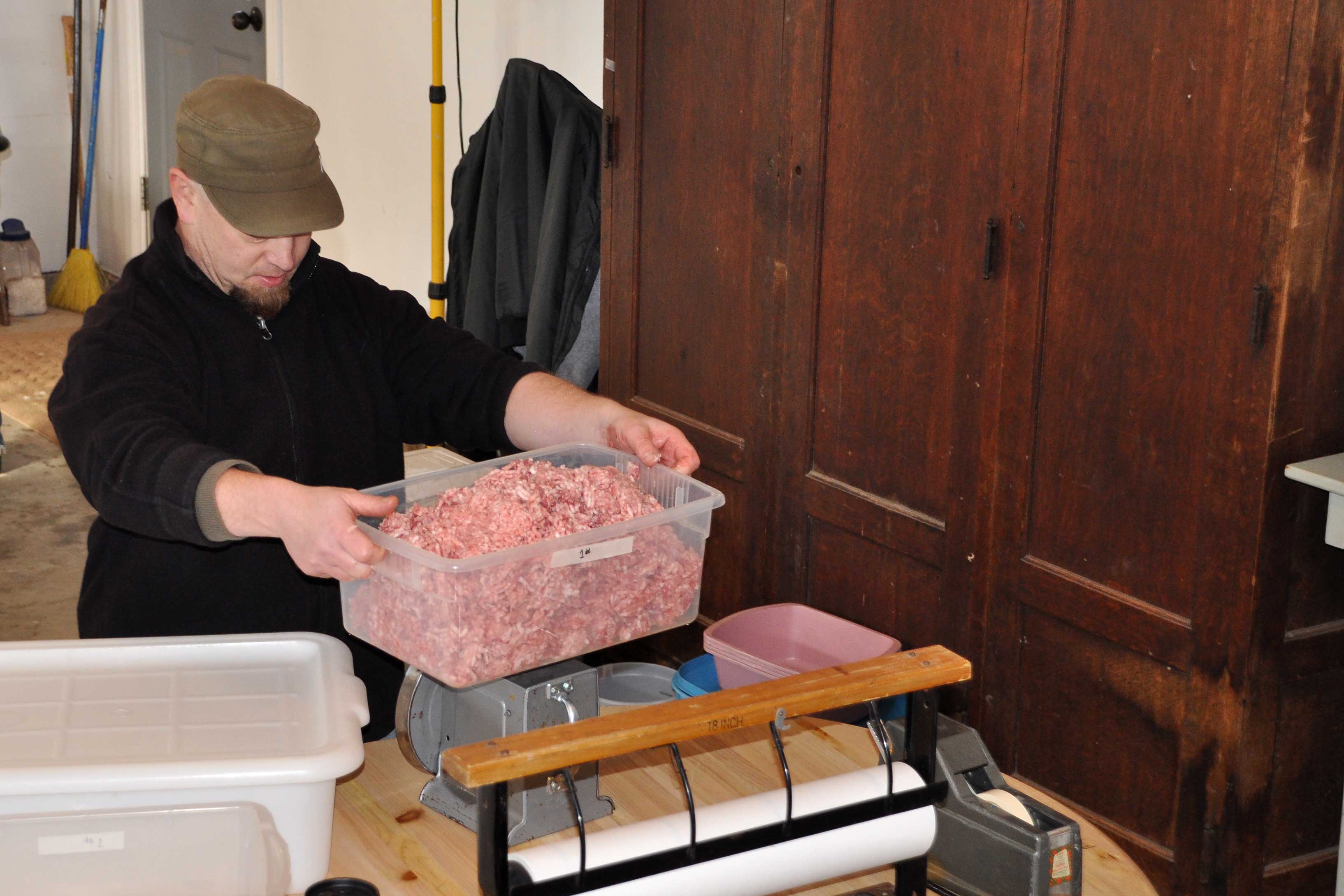
Mixing

Each 30 pound batch of sausage is seasoned with one of those pint jars of spices mixed the night before.  A quart of ice water is also added to the mixture to add moisture and to help distribute the spices.

The mixing is done by hand, usually by two brave people.  The sausage is really, really cold and the spices make your skin itch and burn.  There are discussions about purchasing a hand-crank mixer for next year to improve this part of the process.

Bulk Sausage

After the sausage goes through the mixing process, it is ready to be packaged as bulk sausage or eaten.  We always try out the freshly made sausage for lunch.  It’s always really yummy, even though the spices have not had a chance to fully set.

The grand total for the pork sausage this year was around 300 pounds – 10 of the 30 pound batches.  Of that 300 pounds of sausage, we wrapped about 120 pounds into 1 pound packages of bulk sausage.

Link Sausage

The remaining bulk sausage is processed into links.  I find this part of the process…ummm…interesting.  Mostly because of the use of hog intestines.

The vessel for stuffing the sausage is hog casings, the intestines of the hog.  They are removed during the butchering process, rinsed and packed in salt.  We purchase the casings from the meat locker where we get the hogs.  My daughter and mother-in-law have the job each year of giving these casings another rinse before they are used.

In the first several years of my exposure to the sausage-making tradition, I truly found this part of the process disgusting.  Just the idea of it.  I had a hard time eating the link sausage because of it and would often peel off the casing.  Over time, I have gotten over it and I just try not to think about it too much.  🙂

Stuffing

After the casings are double-rinsed for good measure, they are put on the stuffer.  With one person turning the crank and the other holding the casings, the bulk sausage is stuffed into the casings.

The sausage links are then weighed for record-keeping and to help figure out the amount available for distribution to all the workers.  The total link pork sausage processed this year was 200 pounds.

Venison Sausage

Once all the pork is ground up and mixed, the crew starts cutting up any venison that we have for the year.  This year we had about 60 pounds of venison.  The venison sausage is also mixed in 30 pound batches, with 20 pounds of venison and 10 pounds of pork trimmings.  The rest of the process is the same as the pork, even the spices used.  We make all of the venison into link sausage.

Smoking

The last step in processing the link sausage is cold-smoking.  This family tradition of making sausage is the primary reason Jesse decided to build our smokehouse.  Interestingly, my post on building our smokehouse is the primary search term that brings people to my blog.  If you are interested in building a smokehouse, check out the post here.

The 300 pounds of link sausage is carried tub-by-tub out to the smokehouse and placed on racks for drying.
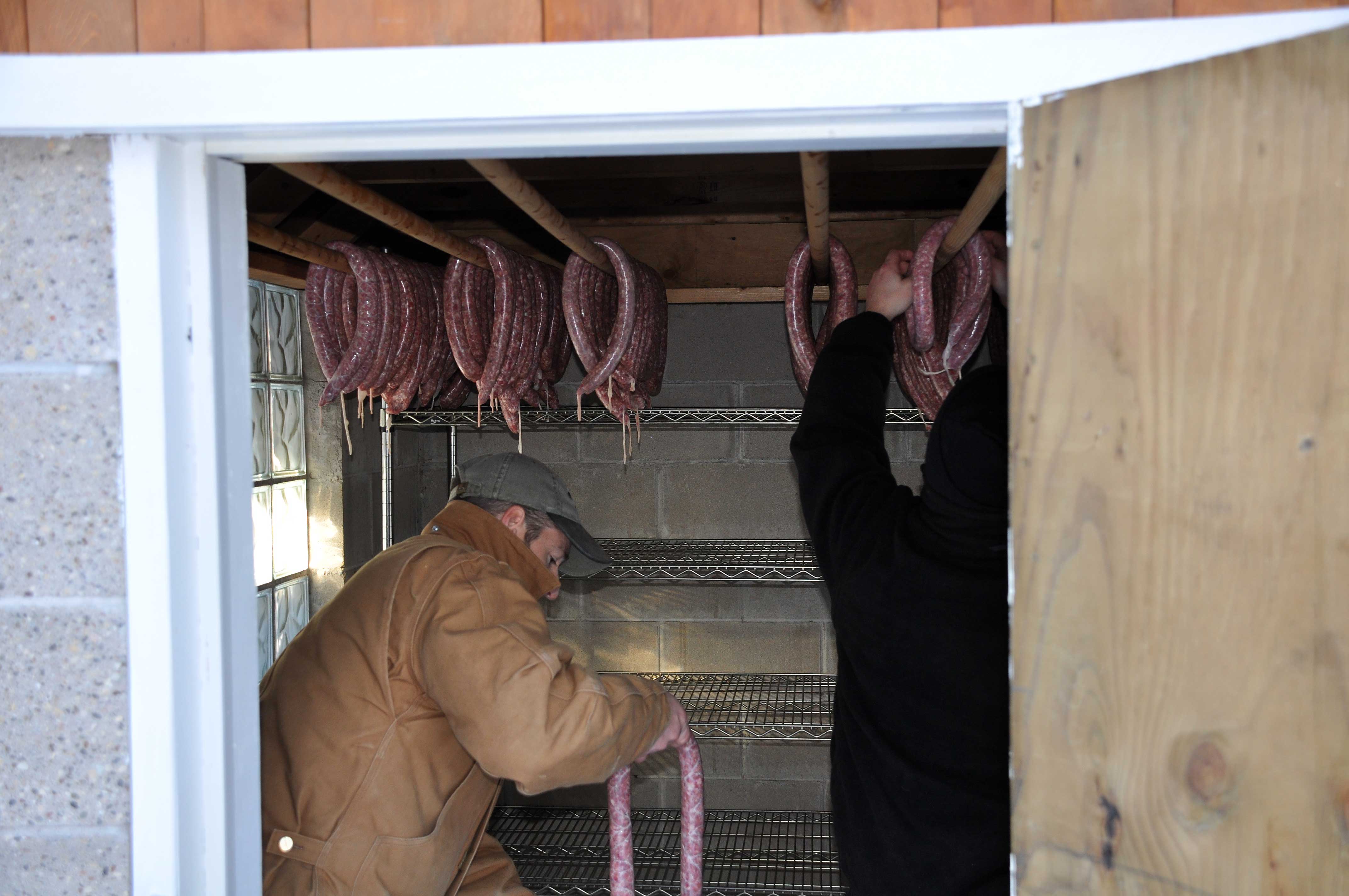
The sausage is hung in the smokehouse to dry overnight to form a pellicle.  The pellicle refers to the tacky surface that develops when food is dried and to which the smoke sticks, thereby adding the desired smokey flavor.


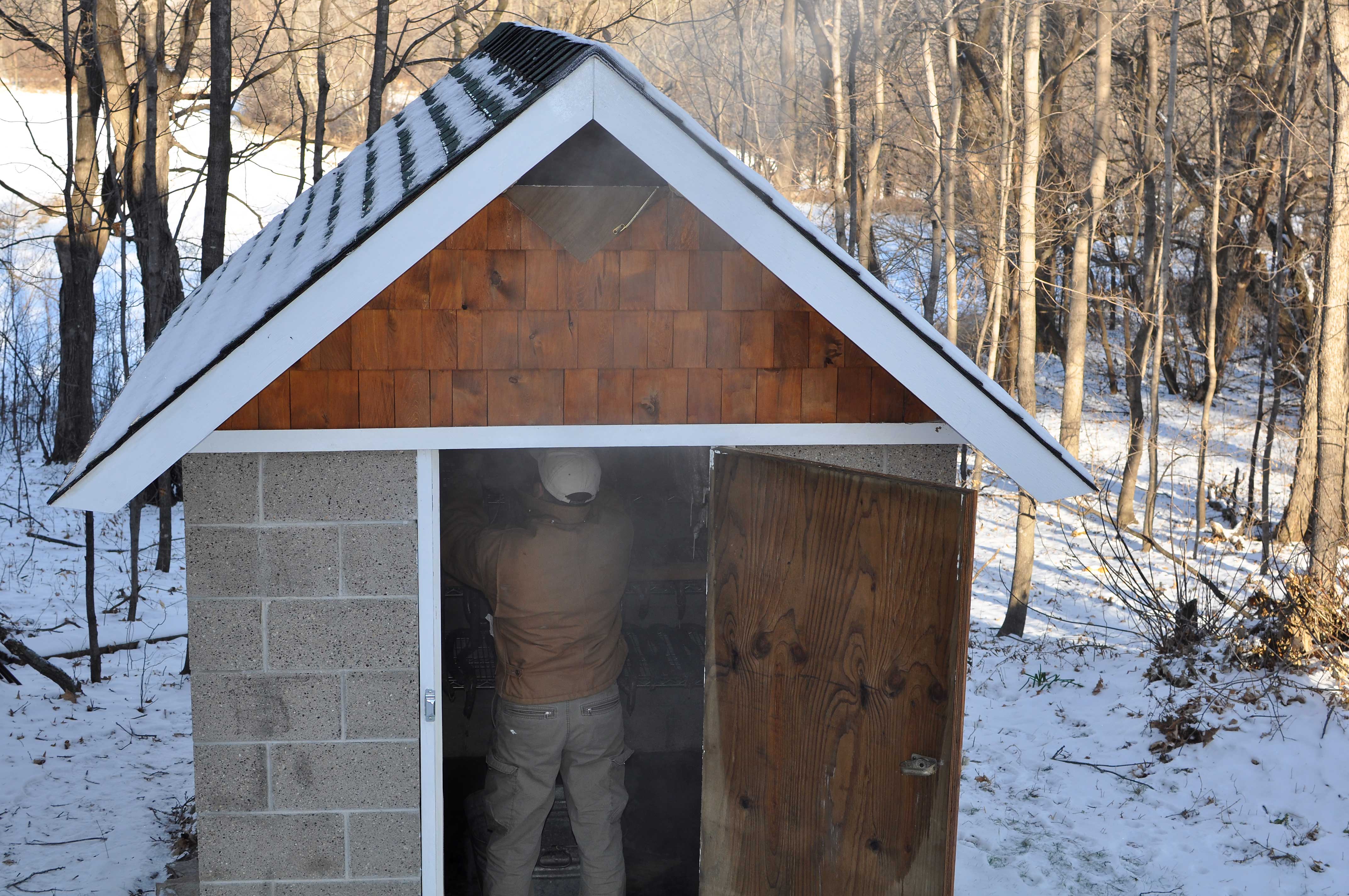
Early the next morning, Jesse fired up the smokehouse to start the cold-smoking process.  The art of cold-smoking is to keep the meat below 70 degrees F to inhibit bacteria growth and to not cook the meat.  (Refer to this post about building our smokehouse for more information on how our smokehouse works).
Wrapping

After about 5 hours of gentle cold-smoking, the link sausage is finally finished and ready for wrapping.  A work crew assembles once more to cut the links into 1 pound servings for packaging in freezer paper.

We divide the sausage between the various individuals and families according to their preference ratios of bulk versus link.

The grand totals of sausage processed for 2010:

120 pounds of bulk pork sausage

200 pounds of link pork sausage

90 pounds of venison sausage

So, after a few long days of hard work and good company we are done making sausage for the year.  In addition to the great family memories we create each year through this tradition, we get to enjoy some amazing sausage over the next 12 months.

Does anyone else make sausage as part of a family tradition?  Please share your stories in the comments!

Lynell


16 Comments

Filed under Food, Smokehouse, Smoking

Dilly-icious Beans!

Thanks to the ranting and raving of various people, I have discovered a great new way to use all of those green beans and wax beans that I am harvesting at the moment.  Over the past few years, when discussing preserving the garden harvest I have heard numerous people mention dilly beans and how much they love them.  I must admit, the thought of pickled beans did not sound that good to me at first.  At some point, however, I just could not ignore the fact that a LOT of people seemed to like these dilly beans.

When the bush beans started producing a few weeks ago, I dug out my canning books and looked for a recipe.  I found several variations and decided to use the following simple recipe out of  The Ball Blue Book Guide to Preserving:

Continue reading

5 Comments

Filed under Food, Freezing and Canning, Gardens, Vegetable

Eat Your Vegetables!

The harvest is on and I cannot pick the vegetables fast enough to keep up.  Although I try to stagger my planting times, every year it seems that everything ripens at once.  At the moment, we have wax beans, green beans, cucumbers, potatoes, carrots, zucchini and onions ready for harvesting and eating.

We have been eating several servings of vegetables at each meal and I keep trying to come up with different ways to slice, dice, chop, spice and serve them to the family.  My kids are pretty picky eaters, however, and their contributions towards vegetable consumption is limited.  Nonetheless, I just keep reminding them to, “Eat your vegetables!”

As any of you that grow your own food already know, produce picked fresh out of the garden and prepared the same day bears little resemblance to store-bought food.  It really is quite unbelievable.

Consider potatoes, for instance.  I have always rejected suggestions of growing potatoes because they are so inexpensive in the store and why would I bother?  We went ahead anyhow and planted them for the first time this year.  Over the last week or so we have started harvesting some to eat.  They are tender, moist, and flavorful!  Butter is no longer a necessary topping (but it is still really, really good).  We never imagined home-grown potatoes could be so much better than those purchased in the store.

And then there are the carrots.  I planted scarlet nantes and rainbow mix carrots this year and their sweet, mild flavor far exceeds the woody and sometimes bitter carrots we usually purchase.

So, we will continue to enjoy these fresh flavors from the garden as long as possible.  I will do my best to harvest, prepare and preserve our home-grown vegetables during our short growing season here in Minnesota.  Then, in the dead of winter, when I am at the grocery store buying produce, I will try to ignore my memories of these summer flavors and console myself with thoughts of next year’s garden bounty.

2 Comments

Filed under Food, Gardens, Vegetable

Preserving Rhubarb

Like most people, we have more rhubarb than we know what to do with. After all, there are a limited number of things you can do with rhubarb, and all of them involve a LOT of sugar to tone down the sharp flavor.  During the harvesting period of spring through the end of June (in my zone 3-4), our daughter usually makes us pans of rhubarb crisp, rhubarb muffins and rhubarb cake to enjoy.  She loves to bake and we love to eat her creations.

This year I decided to attempt preserving some rhubarb to enjoy past its short season.  My first project was to make some simple rhubarb jam.  My husband’s co-worker had an easy recipe for refrigerator jam.

Simple Strawberry Rhubarb Jam

6 c. diced rhubarb

3 c. sugar

Combine and sit at room temperature for 4 hours.

Heat mixture to boiling for 10 minutes.  Add 3 oz. package of strawberry gelatin.

Pour into canning jars.

I am not an expert at canning, or anything else for that matter, but I am trying to learn more each summer as I try to preserve food from the garden.  I boiled the jars of jam in a hot-water bath for 10 minutes just to seal them up.

The resulting jam was very tasty and the consistency out of the fridge was good.

The next recipe I attempted was this ginger rhubarb chutney recipe that I found over at tigress in a pickle.  I discovered her blog a few months ago, along with her companion site, tigress in a jam.  These sites are great resources if you are looking for a collection of recipe ideas for preserving your garden bounty.  In addition to standard pickling and jam recipes, you will find unique and creative recipes with some wild flavor combinations.

Anyhow, this sweet, tangy, and intensely flavored chutney turned out delicious.  After finishing a batch, my daughter and I took some fresh bread with a piece of cheese and put a scoop of chutney on top to test it out.  I loved it and to my surprise, she did too!  Over the weekend, we smoked some pork chops and covered it with the warm chutney, which was also a great pairing.

What other ideas are out there for using or preserving all that rhubarb?

2 Comments

Filed under Food, Freezing and Canning, Gardens, Vegetable

Maple Syrup Adventure: Part II

Our maple syrup adventure is finally winding down.  The sap reluctantly started to run last weekend after the night-time temperatures started dipping below freezing.  By all accounts, this year has not been a great sap run because of the warm temperatures.  We decided to tap more trees along the river once the flood waters receded to increase our quantity of sap.  It was time to start collecting sap last weekend and everyone wanted to get involved.

We have a large water tank that we put on our ATV in the summer to water trees.  The tank functioned well as a collection and holding tank for the sap.  Below the boys are emptying sap into the tank.

Continue reading

3 Comments

Filed under Food, Maple Syrup

Cold-Smoking: Salmon

Prior to building our smokehouse last year, Jesse used a home-made barrel smoker and an electric smoker to do all of his food smoking.  These styles of smokers limited him to hot-smoking, which is a process that actually cooks the meat slowly while smoking it by keeping temperatures above 150 degrees F.

Cold-Smoking

Cold-smoking is an entirely different process that involves keeping the temperature during the smoking process somewhere below 70 degrees F.  The primary reason we built our smokehouse was to be able to cold-smoke the traditional German sausage that Jesse’s family has been making for years. The large size of the smokehouse is because Jesse wanted to have the capacity to smoke 400-500 lbs of the sausage in a single batch instead of staying up nights tending the firebox. A nice side benefit is that he is also able to cold-smoke fish, cheese, ribs, chickens, turkeys, etc… which turns out a completely different product from hot-smoking.

The key design criteria for cold-smoking is to locate the firebox away from the smoking chamber to allow the smoke to cool before entering the smoke chamber. In Jesse’s design he has located the firebox 8 feet away and slightly down the hill from the smokehouse. The firebox and flue are built into the hillside, which allows the heat to be pulled out by the cooler soil temperature. It is also important to make sure that the flue pipe is at a slight incline to encourage proper drafting of the smoke from the firebox into the smokehouse and out the roof venting. Adequate venting is important to make sure that moisture does not build up in the smokehouse.

Making Cold-Smoked Salmon

Jesse cold-smoked some salmon last weekend.  It was his second attempt and the texture and flavor turned out much better this time.  The first attempt was with refrigerated salmon with no skin attached. The second attempt was with frozen wild salmon provided by a co-worker. We have found some information that frozen salmon is actually preferred for cold-smoking because it enables the curing process.

Before cold-smoking, the salmon needs to be thawed and cured.  Curing preserves meat or fish with salt.  There are endless variations of curing recipes, but the dry cure recipe that Jesse used this time was from Charcuterie; The Craft of Salting, Smoking and Curing. This book provides a wealth of information on these topics and has been an invaluable learning resource.

The dry cure recipe called for the following ingredients:

  • 1/2 cup kosher salt
  • 1/4 cup dark brown sugar
  • 1/4 cup sugar
  • 1 tsp. pink salt
  • 1 tsp. ground white pepper
  • 1 tsp. ground allspice
  • 1/2 tsp. ground cloves
  • 1/2 tsp. ground mace
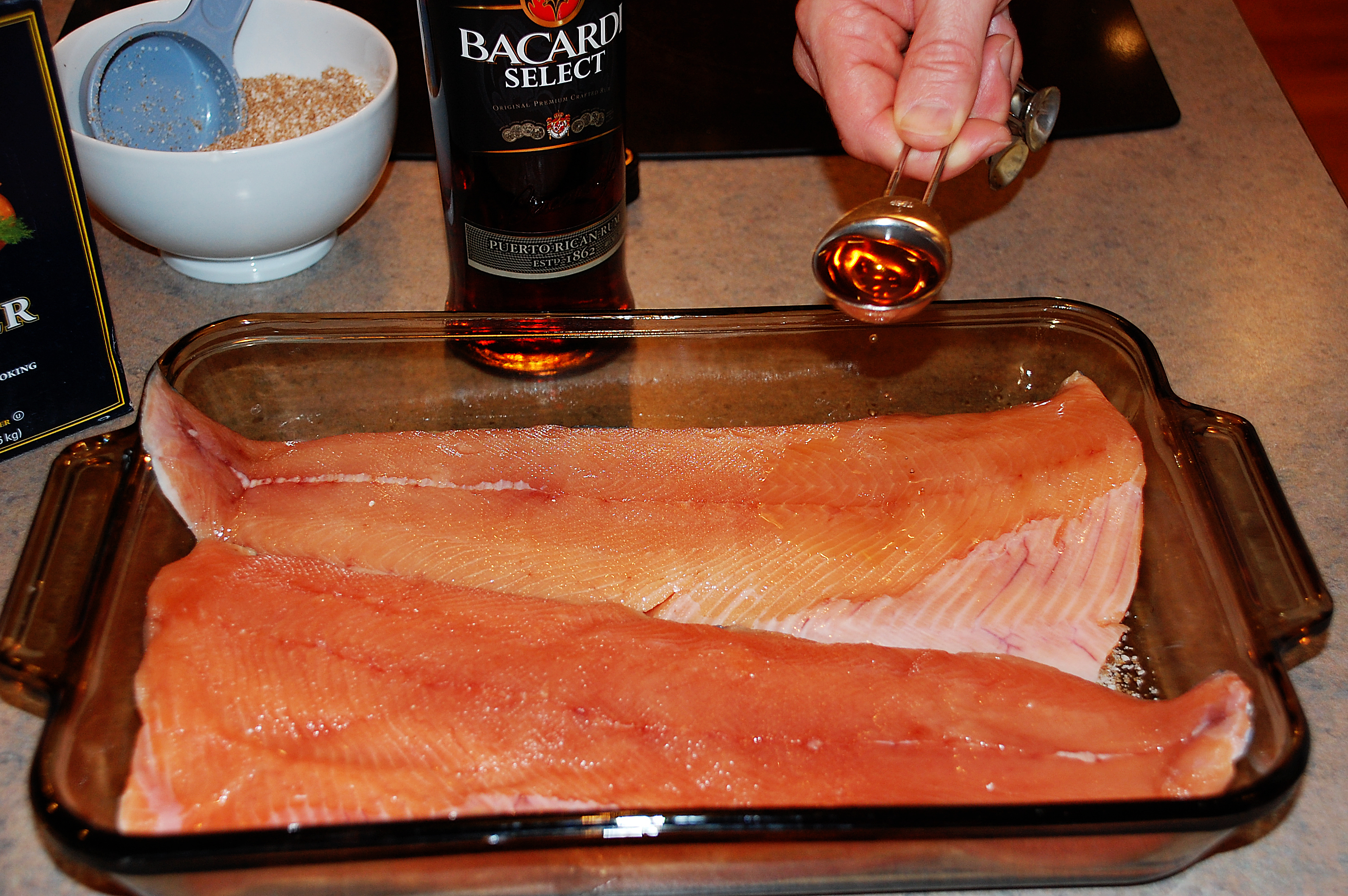
  • 1 1/2 T. dark rum
  • 1 1/2 lbs. salmon fillet in one piece (skin on is preferable)

After mixing all the dry cure ingredients together, spread half of the mixture out in a dish or pan.  It is helpful to choose a dish that is around the same size as the salmon fillets because the curing process extracts liquids out of the fish.  Having a dish around the same size allows these liquids to remain in contact with the fish and becomes a natural brine for curing.

Time to sprinkle on the dark rum and add the rest of the dry cure mixture over the top. Make sure to sample the rum during this part of the process to make sure it is of good quality.

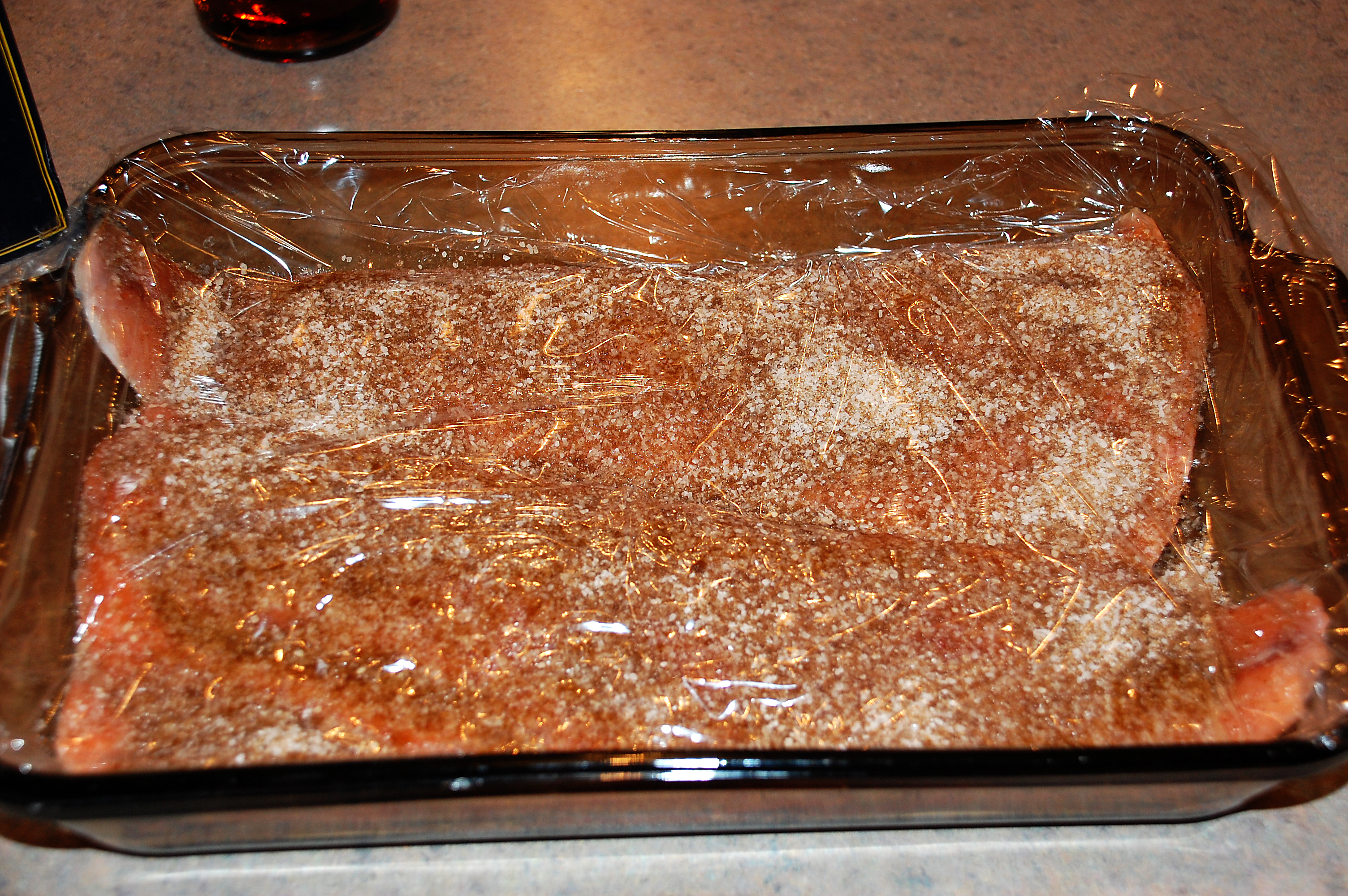
Once the salmon is covered with the remaining dry cure, cover it with plastic wrap. Sample the rum again, just to be sure.

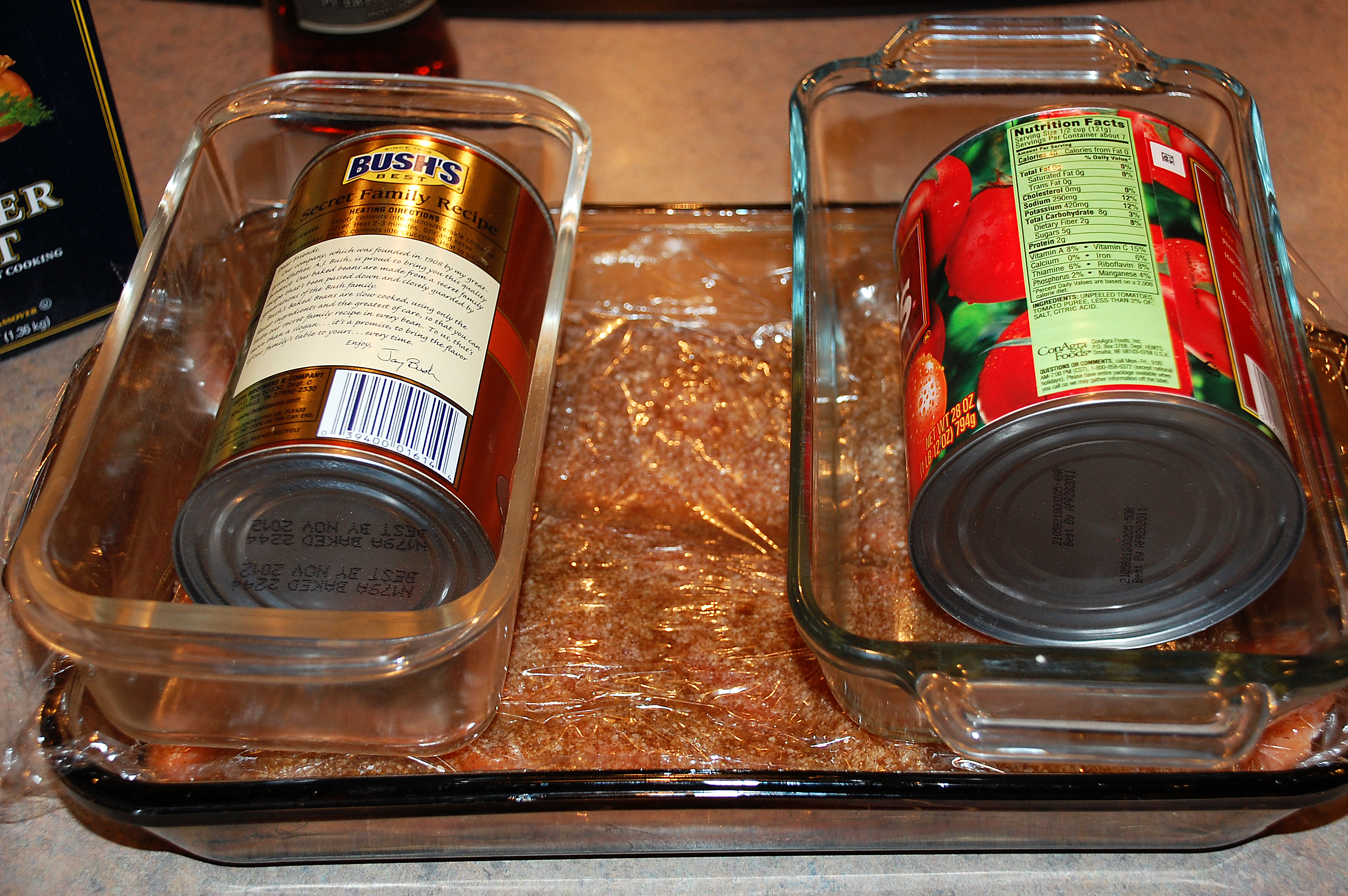
Place a pan (or pans) on top of the salmon and put some type of weight in it to help extract the moisture.  We used cans and a dressing bottle in between for weight.

Now it is time to put it in the refrigerator and let the curing process begin! It wouldn’t hurt to sample the rum again for good measure.

Jesse let the salmon cure for about 36 hours.  You can tell when the curing process is complete because the salmon will become firm.

Once it is finished curing, it needs to be rinsed thoroughly under cold water to remove the excess salt.

After patting it dry with paper towels, we placed it on a rack out on the screen porch to dry.  Drying is also an important part of the process because it allows the food to form a pellicle. The pellicle refers to the tacky surface that develops when food is dried and to which the smoke sticks, thereby adding the desired flavor.  We dried the salmon for about 6 hours, but it could dry cure for up to 12 hours if needed for pellicle formation.

It’s finally show time!  Time to fire up that smokehouse.  Jesse used maple wood to smoke the salmon. His first attempt was with oak wood because he forgot he had a whole tree worth of maple sitting behind the garden. The maple wood had a much mellower flavor that we enjoyed.

I could not resist poking fun at these two little salmon fillets taking center stage in this ridiculously large smokehouse, but Jesse reminded me that the operating costs were still zero since the wood was stacked head high from a downed tree in the woods.

We thought the salmon was too smokey last time after being smoked about 6 hours, so this time he only smoked it for about 4 hours. Just about the right amount of smoke for our tastes.

After all the work that went into building the smokehouse, it is fun to see it get some use (even if it only for two measly slabs of salmon).

The finished product!  I think it is best on a cracker with a thin layer of cream cheese.  The smokey flavor was perfect;  not too overpowering. Jesse will fine tune this recipe with some fruit woods in the future, and he has promised to also work harder to remove ALL the pin bones next time!

3 Comments

Filed under Food, Smokehouse, Smoking

Spring Flooding and Maple Miscalculations

Remember last week, before we left for our trip, when we tapped a few of our  maple trees in the river bottom behind our house?  The pails sat safely next to the base of the trees, waiting to catch the sap when it starts to flow.

Apparently it rained nearly the entire time we were gone.  It rained a lot and the snow melted…a lot.  We arrived home Thursday night surprised to see how much of the snow was gone.

It was still raining on our drive home from the airport.  It was evident that winter was on its way out and the dreariness of spring was upon us.  In the morning, I glanced out the windows in the back of the house towards the river.  Sadly, our tree-tapping experiment had gone awry.

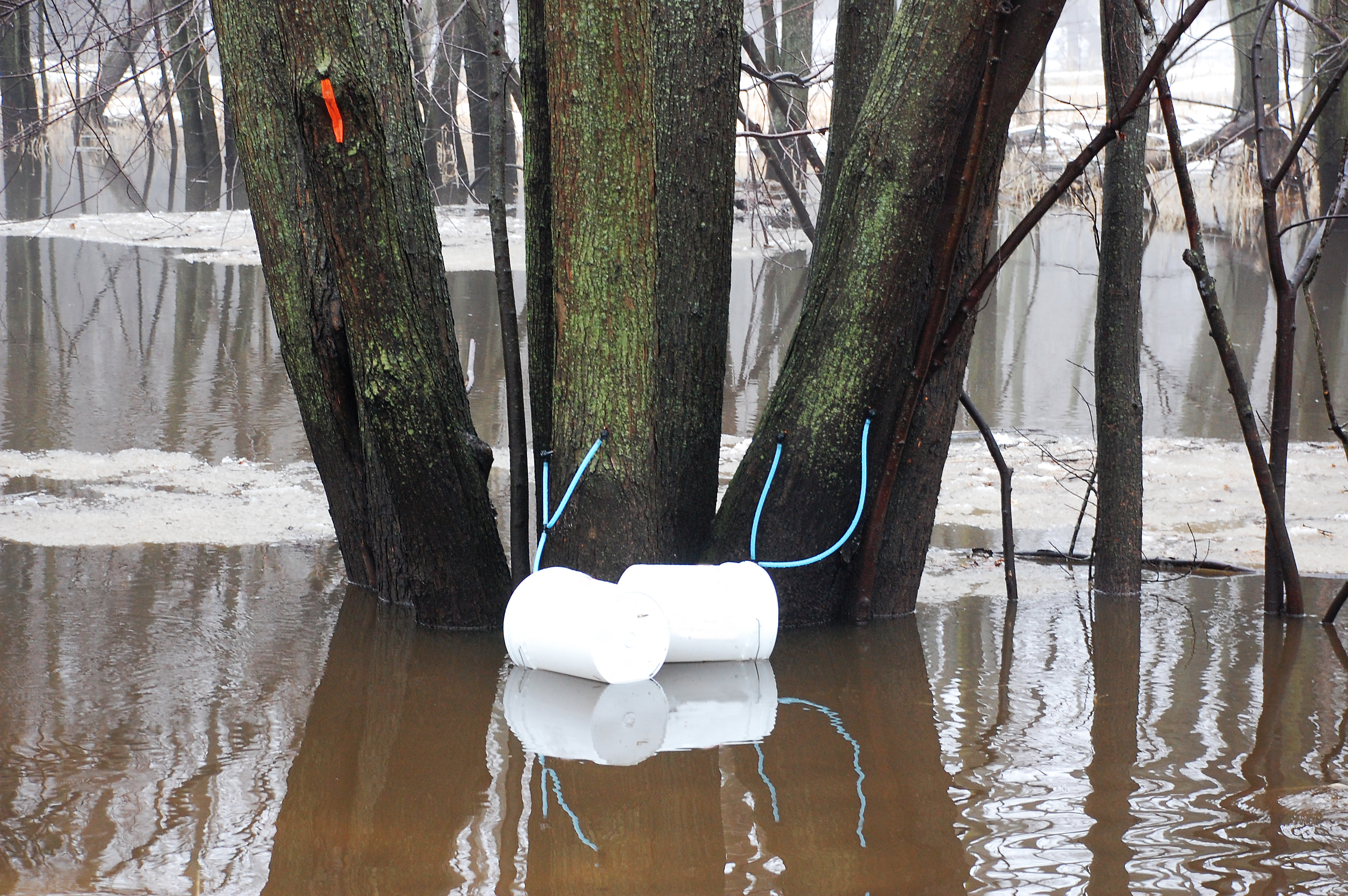
The river has already flooded, a little earlier than usual.  The flood waters have interfered with our first attempt to collect the sap out of the maple trees.  Instead of sitting safely next to the tree, the collection pails are floating in the swollen river.  We need a new plan.  Despite my frustration over the floating pails, I do find the flooded river bottom eerily beautiful.

Wasting no time, Jesse formulated a plan to retrieve the pails.  Using the scow boat, he floated out to the pails and gathered them up.

We located more maple trees on higher ground behind the house and drilled new holes for the taps.

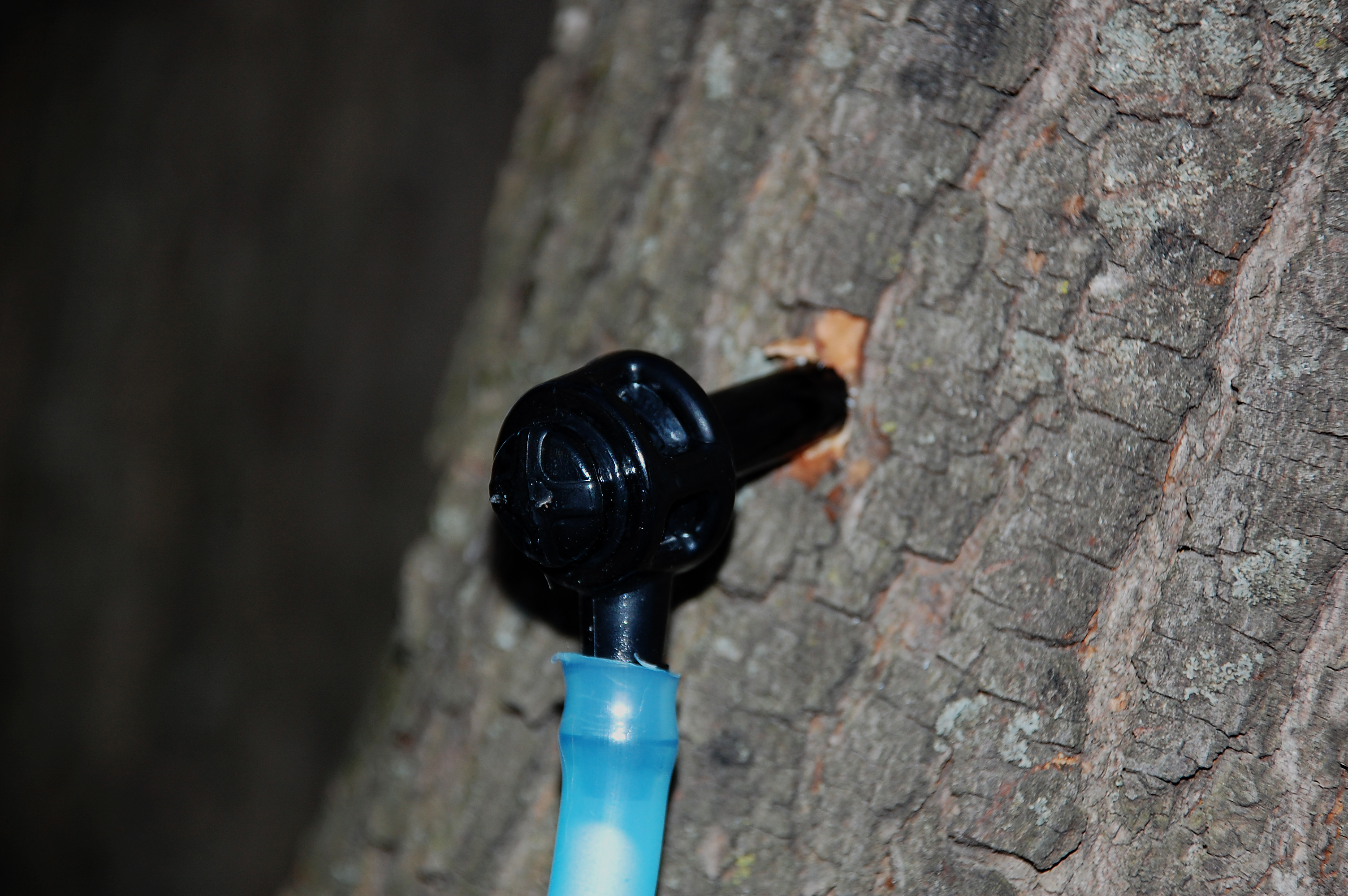
Once the spiles were inserted, some sap started dripping out.  We were so excited!!

So excited that our daughter did not want to see it go to waste.  She said that it only has a hint of sweetness.

Once again, we are all set up and waiting for the sap to really start flowing.   Let the adventure continue…

1 Comment

Filed under Daily life, Maple Syrup

Maple Syrup Adventure – Part I

The river bottom behind our house is filled with large maple trees.  As if we aren’t already busy enough trying to keep up with all of our kids’ activities and our other projects around the farm, we decided to try to make our own maple syrup after – you guessed it – seeing this great article entitled “Sugar From Trees” in the March/April 2009 issue of Minnesota Conservation Volunteer.  Our beekeeper friend also produces and sells maple syrup on a larger scale and Jesse went to observe his operation last spring.

Last fall, while the trees still had leaves, we identified sugar maple trees and marked them with orange tape.

As the weather started to warm up during the days this week into the low to mid 40’s (“warm” is a relative term when you live in Minnesota), we knew it was time to get the trees tapped.  The best syrup is made from maple sap after it first starts to run in the spring.  Tree sap starts to flow when temperatures rise above freezing during the day but fall back below freezing at night.

To tap the trees, Jesse and our oldest drilled holes into the tree trunks and inserted spiles. Sap drips out of the tree during the warm days and into the spile.  We purchased plastic spiles on-line from Leader Evaporator, but there are also metal ones.  I’m not sure why we got plastic, other than it was more cost-effective.

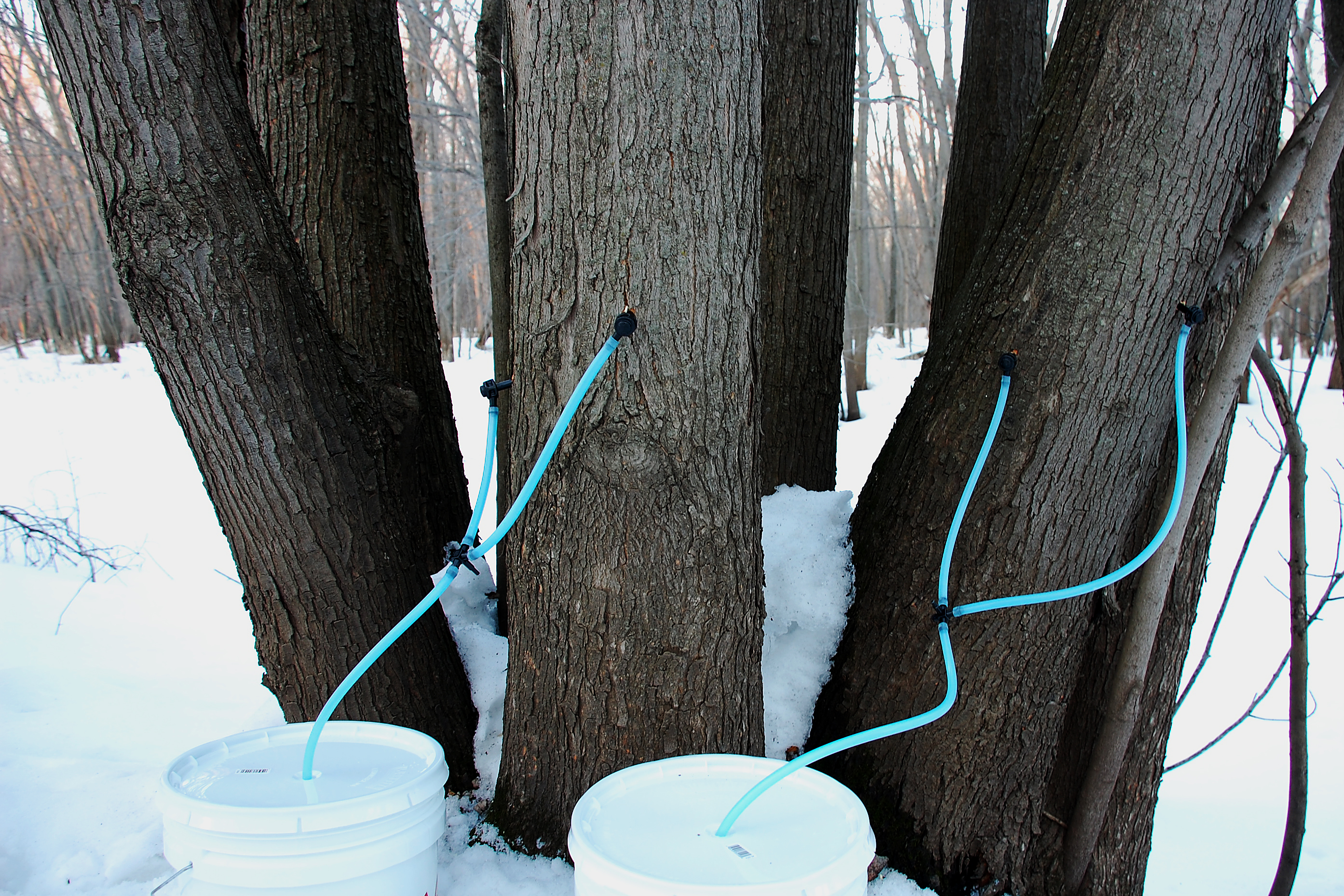
We also purchased some tubing to attach to the spiles to direct the sap into buckets sitting next to the trees.

The length of the sap run can vary, sometimes ending after only a few weeks.  Even though the tree sap flows through fall, once the weather warms up and stays above freezing at night, any syrup made from the sap won’t taste good any more.

We tapped a total of five trees, each with two spiles running into a five gallon bucket.  The temperature had already dropped below freezing when they were tapped tonight, so it was not evident whether the sap is running yet.  We have a large plastic drum to collect the sap in so that we can refill the buckets.  It takes around 40 gallons of sap to make a gallon of syrup!

There are a lot of steps that need to successfully be completed between collecting the sap and having maple syrup.  We need to collect the sap, keep it cool, cook it down the right amount, and boil it to the proper temperature.  I have no idea how this adventure will play out, but it always fun to try something new…even if we don’t really have the time.

3 Comments

Filed under Daily life, Food, Maple Syrup

A Lesson in Thai Cooking

We have known our friends Paul and Rashimah for a long time.  Paul has worked with my father in the real estate business for years and their daughter is a good friend to our daughter of the same age.  He is also an experienced beekeeper and was generous with his time and wisdom in mentoring us through our first summer with bees last year.  Rashimah is a native of Thailand and they met while Paul was working overseas.  They are kind, generous, worldly, open-minded, interesting….you get the idea.  We love being around these people.

In addition to these many great qualities, Rashimah is also an amazing cook.  Food prepared by her is always the main attraction at any potluck.  The personal favorite of myself and many others, are Rashimah’s fresh and fried spring rolls.  After searching out and occasionally attempting recipes for spring rolls, I was always left disappointed.  They were never as tasty or neatly rolled as Rashimah’s.

My sister and I finally mentioned to Rashimah that if she was willing, we would love to learn her secrets and techniques for the perfect spring rolls.  She generously offered to teach us and our schedules finally allowed us to have our lesson in Thai cooking last Sunday.  Paul and Rashimah invited us into their home, where Rashimah walked us through making fresh and fried spring rolls, Pad Thai and her version of fried rice.  I took photos along the way and my sister took notes so that we could try to produce results similar to her cooking on our own.  Rashimah sells her delicious food at various music festivals during the summer, so of course I can’t give away all of her “secrets” to the perfect spring rolls.

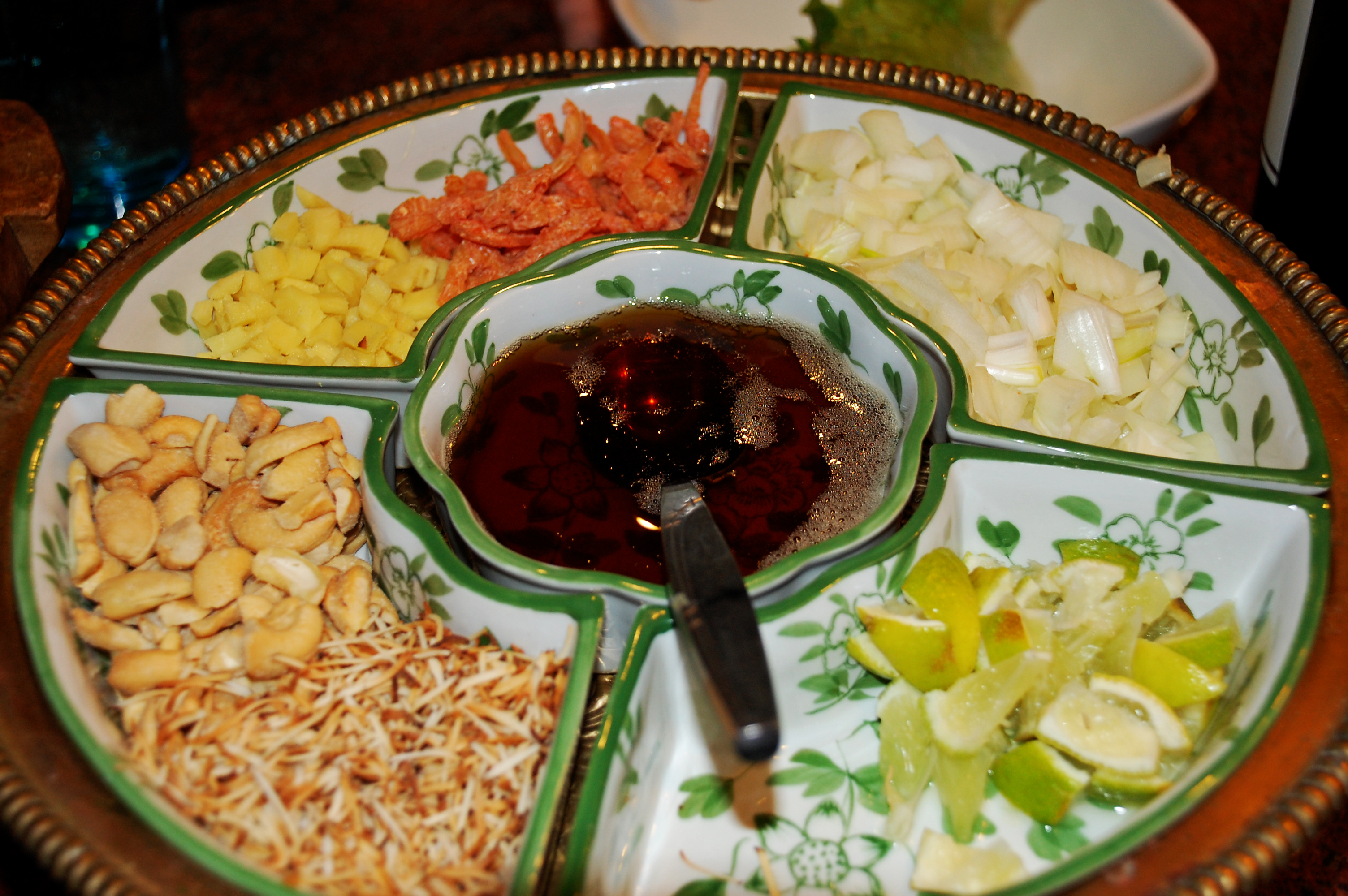
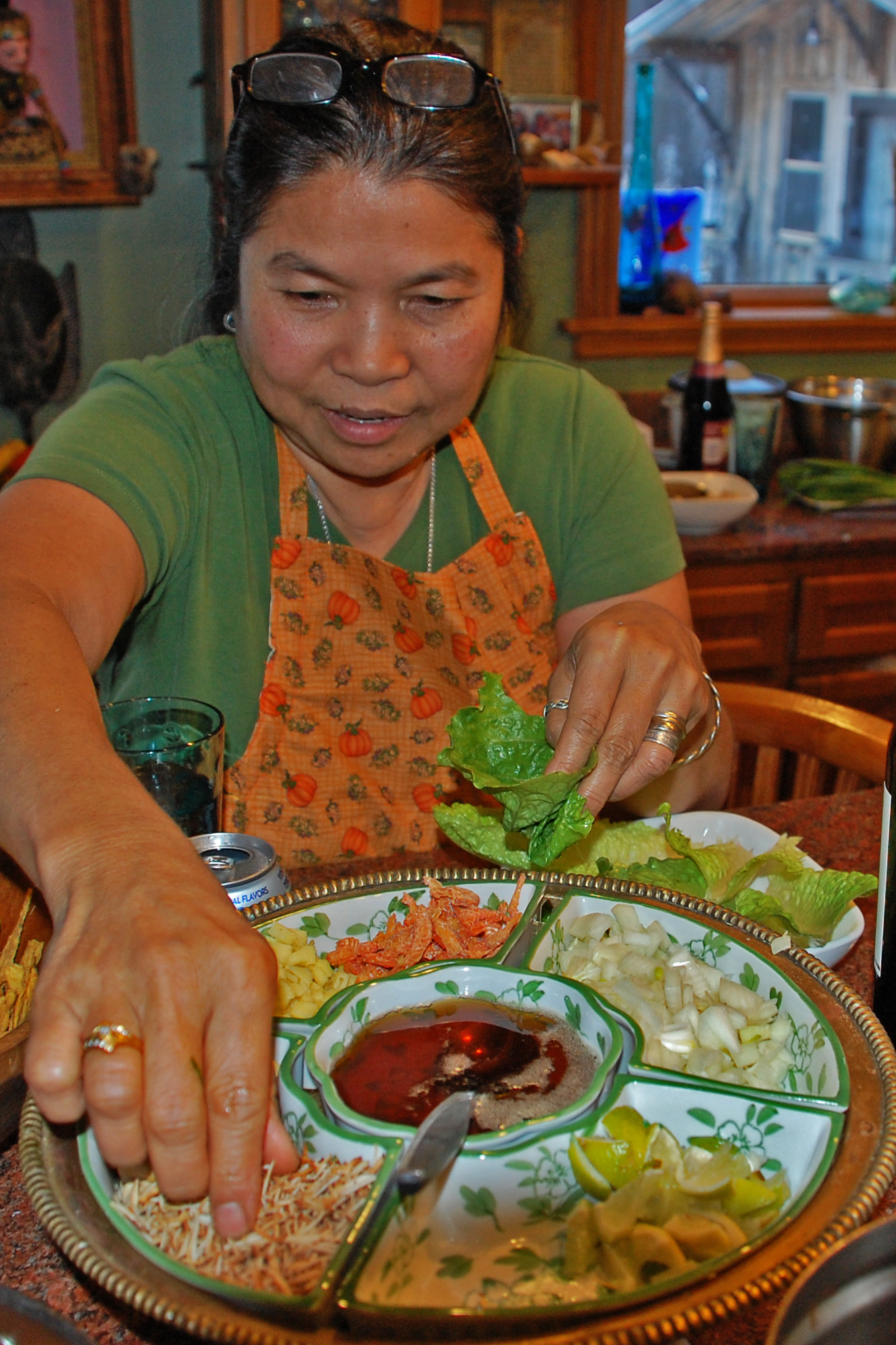
We enjoyed a lovely traditional Thai appetizer to start out our cooking lesson.   The platter included dried shrimp, toasted coconut, cashews, diced onions, ginger, and limes.


Rashimah demonstrates how to eat the snack by folding up the lettuce and placing a little of each ingredient inside, topped off with a drizzle of maple syrup.  She explained that in Thailand they would use some other sweetener rather than maple syrup, but since her and Paul produce maple syrup on their farm, that is what she prefers to use.  The combination of flavors and textures made a light and fresh tasting snack!

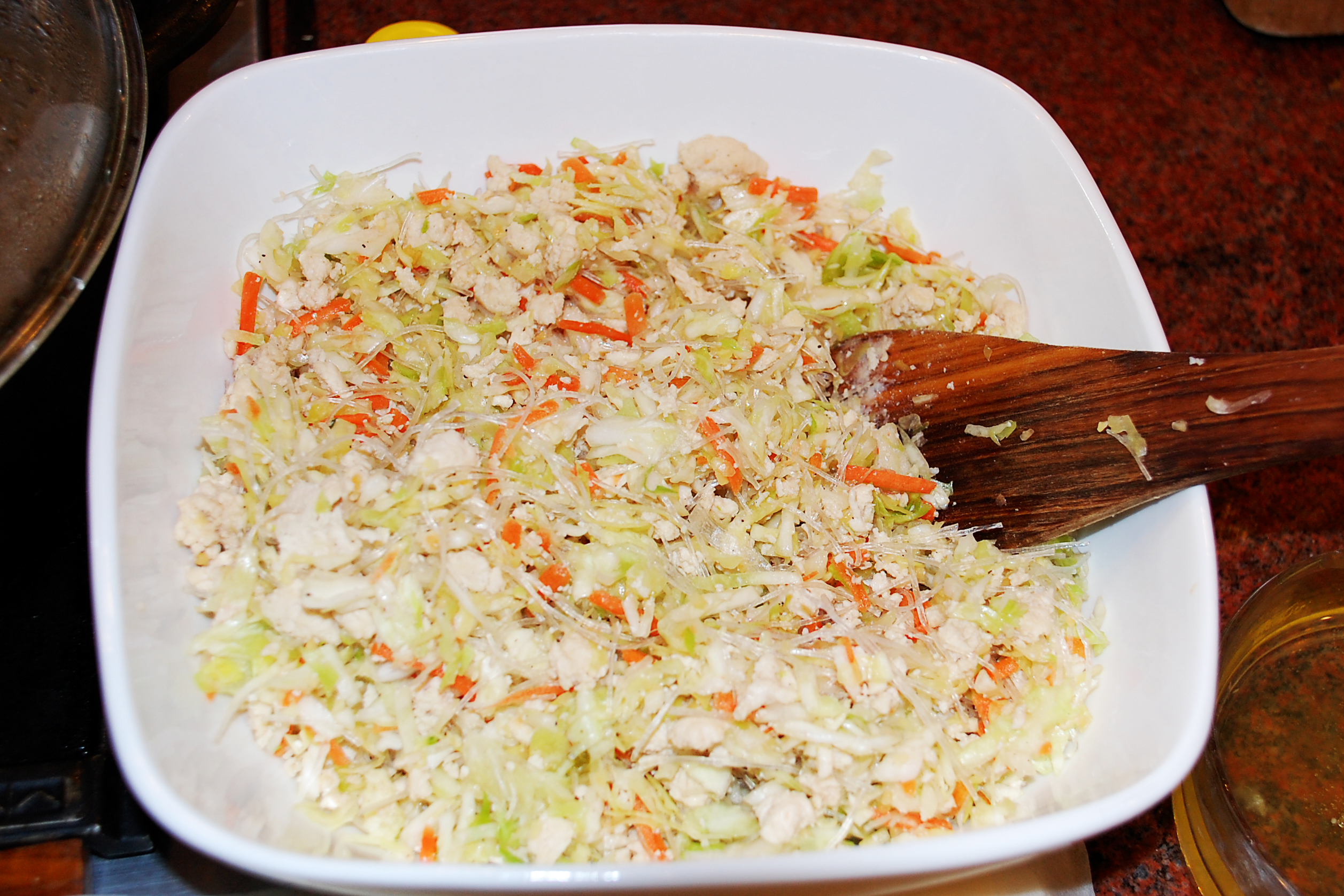
Our first lesson in Thai cooking was to learn how to make fried spring rolls.  Rashimah prepared the mixture of shredded chicken and cabbage for the filling.

She then demonstrated how to roll the spring roll tightly so that it fries up nice.  She makes it look so easy.

Next, we fried the spring rolls in hot oil until they were golden brown.

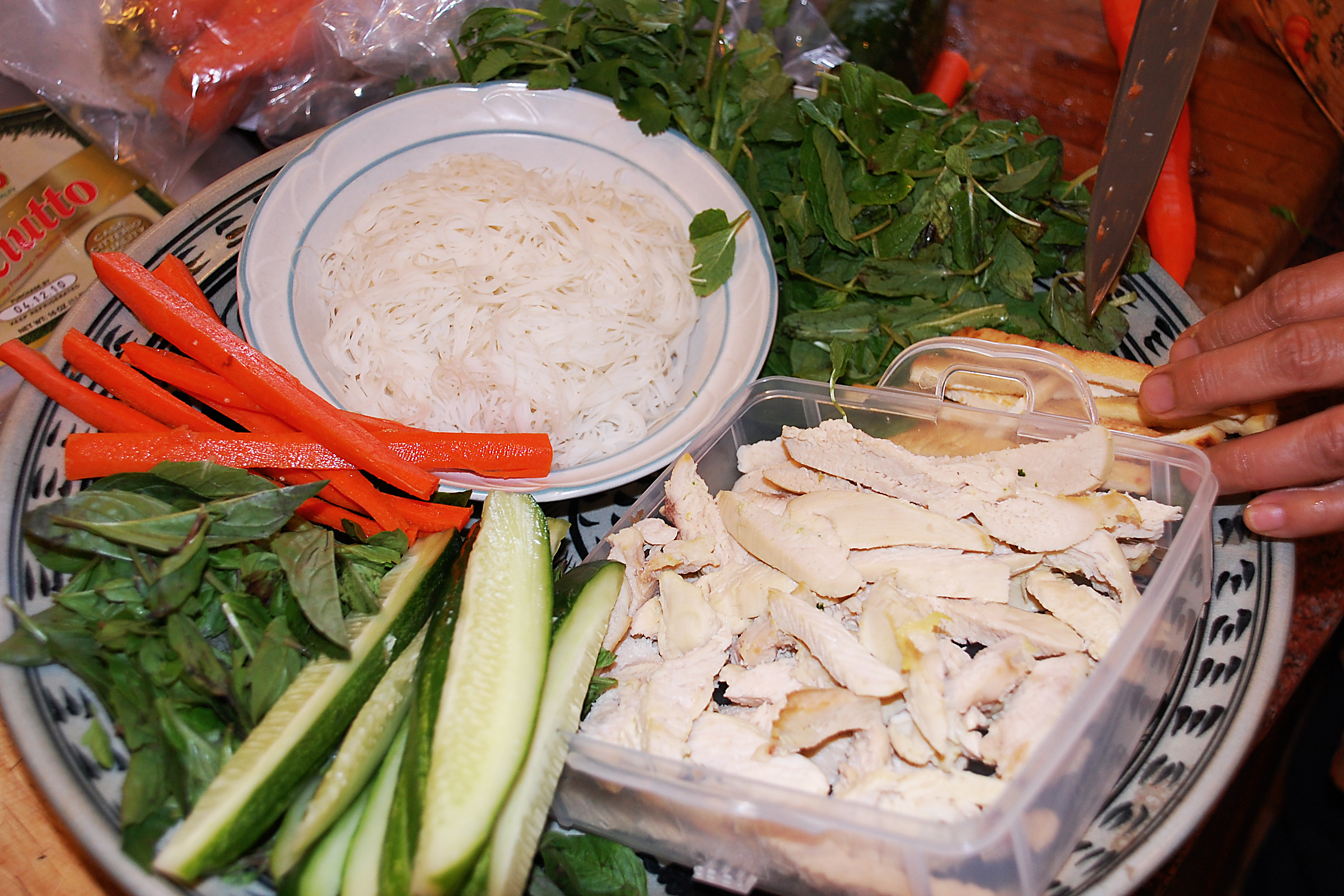
Moving on to my absolute favorite….the fresh spring rolls.  We started out by preparing a beautiful platter of fresh ingredients.  There are no hard and fast rules on what to put into the fresh spring rolls, but she had cut up chicken, fried tofu, carrots, cucumbers, lettuce, cilantro, mint and basil.  We also had thinly sliced eggs and some rice noodles to add.

In the photo below, I am carefully laying the ingredients on to the rice paper before I attempt to roll it all up.  In the past, my problem has always been that I end up tearing the rice paper as I’m rolling in the ingredients.  After watching Rashimah, I realized that I have most likely soaked the rice paper too long, thereby making it weak and more prone to tearing.  Following her example, I had no issues rolling up the spring rolls.  I still couldn’t get mine as tightly rolled as Rashimah, but she assured me that this would come with practice.

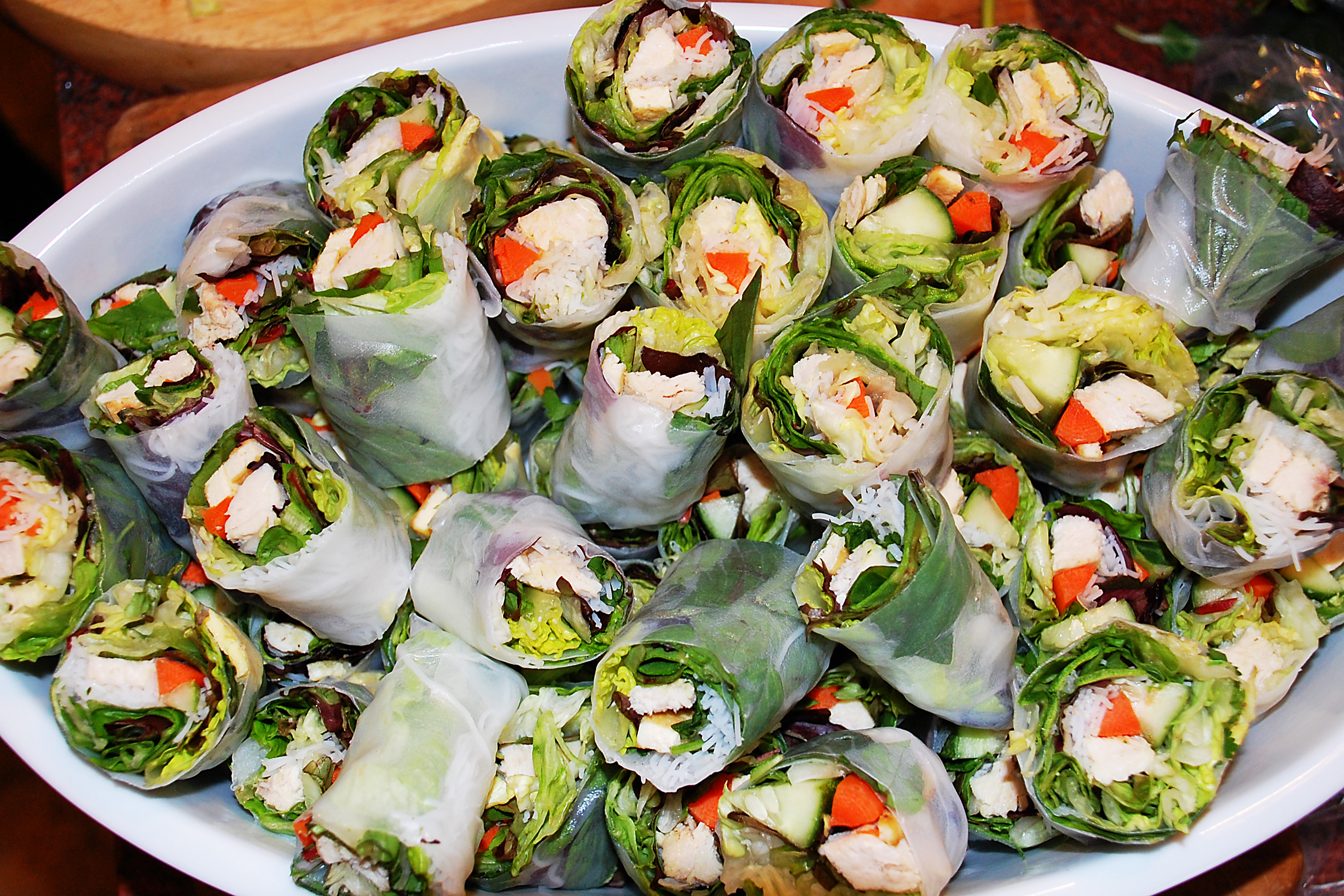
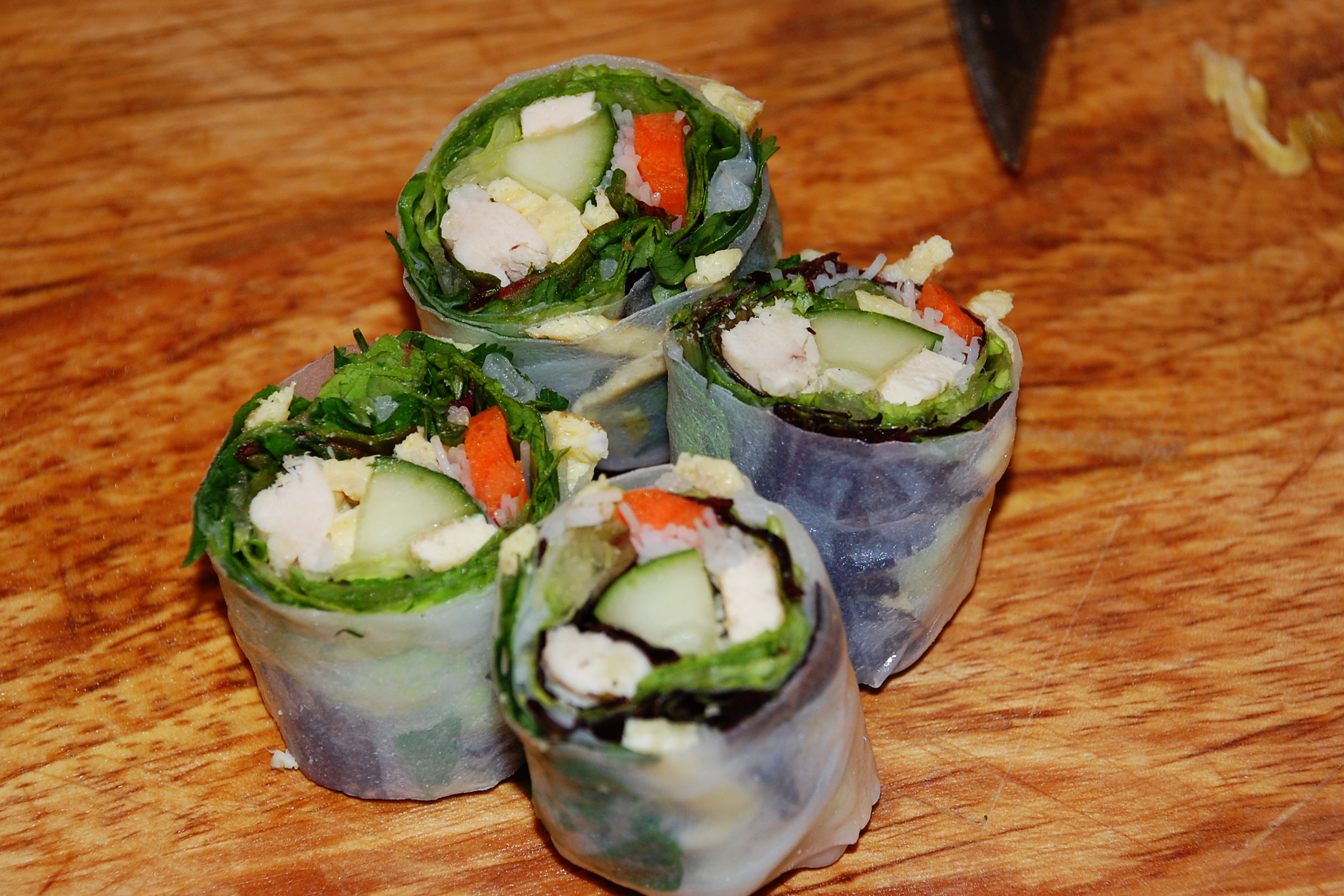
The finished product.  Beautiful.  Fresh.  Healthy.  Delicious.


Leave a comment

Filed under Cooking, Daily life, Food